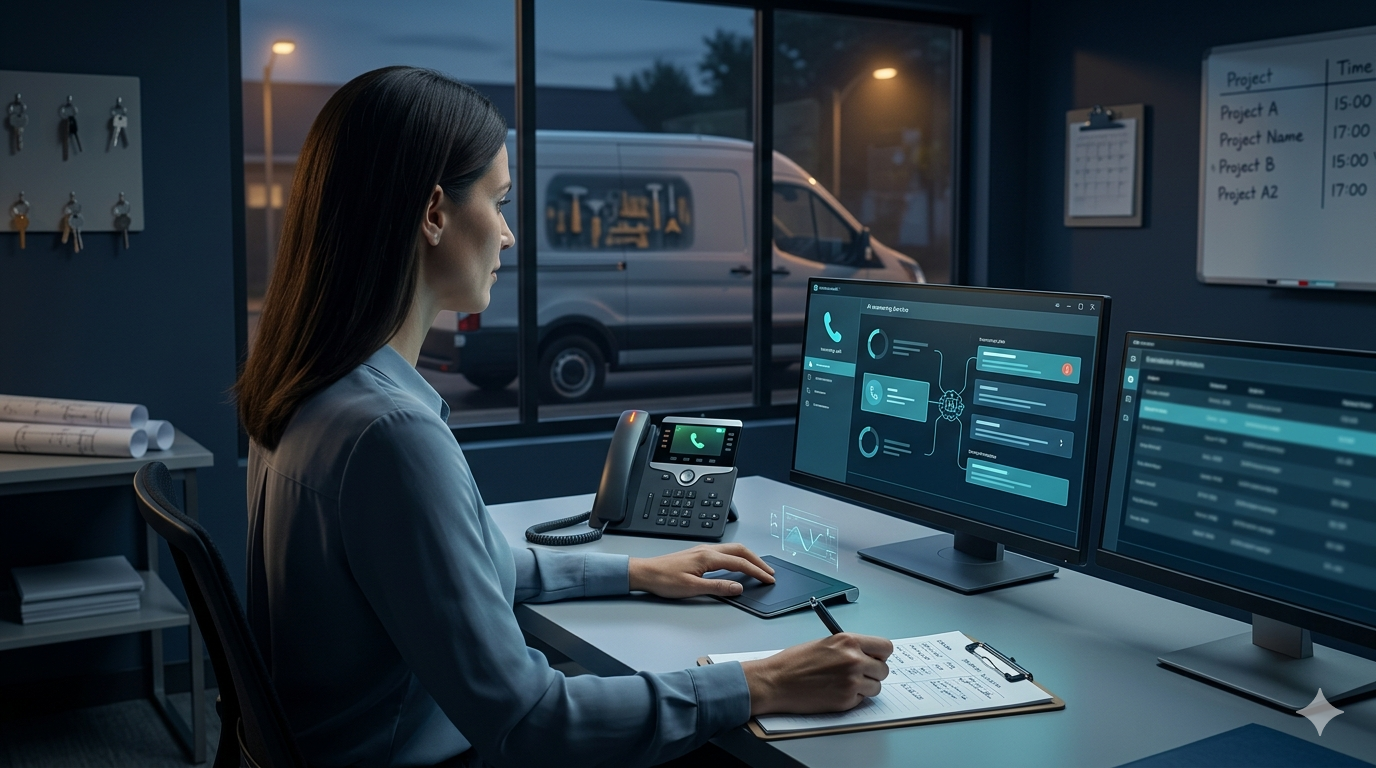
A contractor can spend heavily on demand and still lose the job when the phone rings. The homeowner with no cooling, a leaking water heater, or storm damage is rarely committed to one company. If the first call goes unanswered—or reaches someone who cannot explain what happens next—the next search result gets a chance.
An AI answering service can close that coverage gap, but the voice demo is the least important part of the buying decision. Test whether the service can recognize the call, collect usable facts, make only promises the company can keep, and hand the work to the right person. Contractors should buy an operating system for the start of a customer relationship, not a talking inbox.
Define the coverage problem before shopping
Start with call records, not product features. Review several weeks of missed, abandoned, after-hours, overflow, and transferred calls. Separate new opportunities from existing-customer questions, vendor calls, spam, and internal traffic. Then identify the failure that costs the business most.
One company may need overnight emergency capture because its on-call technician receives incomplete voicemails. Another may need lunch-hour overflow because two CSRs cannot answer three lines at once. A remodeler may care less about immediate booking and more about screening project type, location, budget readiness, and desired start date.
Write the first use case in one sentence. For example: “Answer new plumbing calls after 5 p.m., identify active leaks, collect the service address, and alert the on-call manager.” A narrow job is easier to configure, test, and measure than a vague mandate to automate the phones.
Map calls into lanes the office already understands
The answering workflow should follow the company’s real operating lanes. Most contractor calls fit a small number of categories:
- a new service request that may be booked
- an urgent condition that needs immediate escalation
- an estimate or project lead that needs qualification
- an existing customer asking about arrival, scope, billing, or warranty
- a caller outside the service area or outside the company’s work
- a supplier, applicant, salesperson, or other non-customer call
Each lane needs an owner, required information, and an honest next step. If the office has no process for warranty questions, adding AI will not create one. Resolve ownership before the system begins routing live callers.
Decide where automation stops
Call capture and appointment booking are different levels of risk. Capturing a name, callback number, ZIP code, service category, and short problem description is relatively controlled. Booking can involve technician skills, travel zones, membership priority, job duration, parts availability, and schedule rules that change during the day.
Allow direct booking only when the answering service reads current availability from the system of record and follows the same rules as the office. Otherwise, offer a callback window instead of inventing certainty. “Our scheduling team will call you by 8:30 tomorrow morning” is better than a confident appointment the dispatcher must undo.
The same restraint applies to price. A system may communicate a verified dispatch fee or an approved range if the business has defined the conditions. It should not estimate repair cost, diagnose equipment, promise coverage, or improvise discounts from a caller’s description.
Build an emergency path that is short and specific
Urgent calls should not pass through a long qualification script. Define the signals that trigger escalation for each trade and market: active water flow, loss of heat during severe cold, electrical burning smells, sewage backup, storm exposure, or another condition the company has chosen to prioritize.
The system’s role is to recognize the signal and route it, not to diagnose the hazard. Use approved safety language, collect the minimum details the responder needs, and connect or alert the designated person. If no one accepts the escalation, define a second path and the exact expectation given to the caller.
Test false positives as well as obvious emergencies. An aggressive rule can wake the on-call team for routine scheduling; a weak rule can bury a real emergency in the morning queue. The right threshold reflects the company’s capacity, service promise, and insurance or safety guidance.
Make the handoff useful without replaying the call
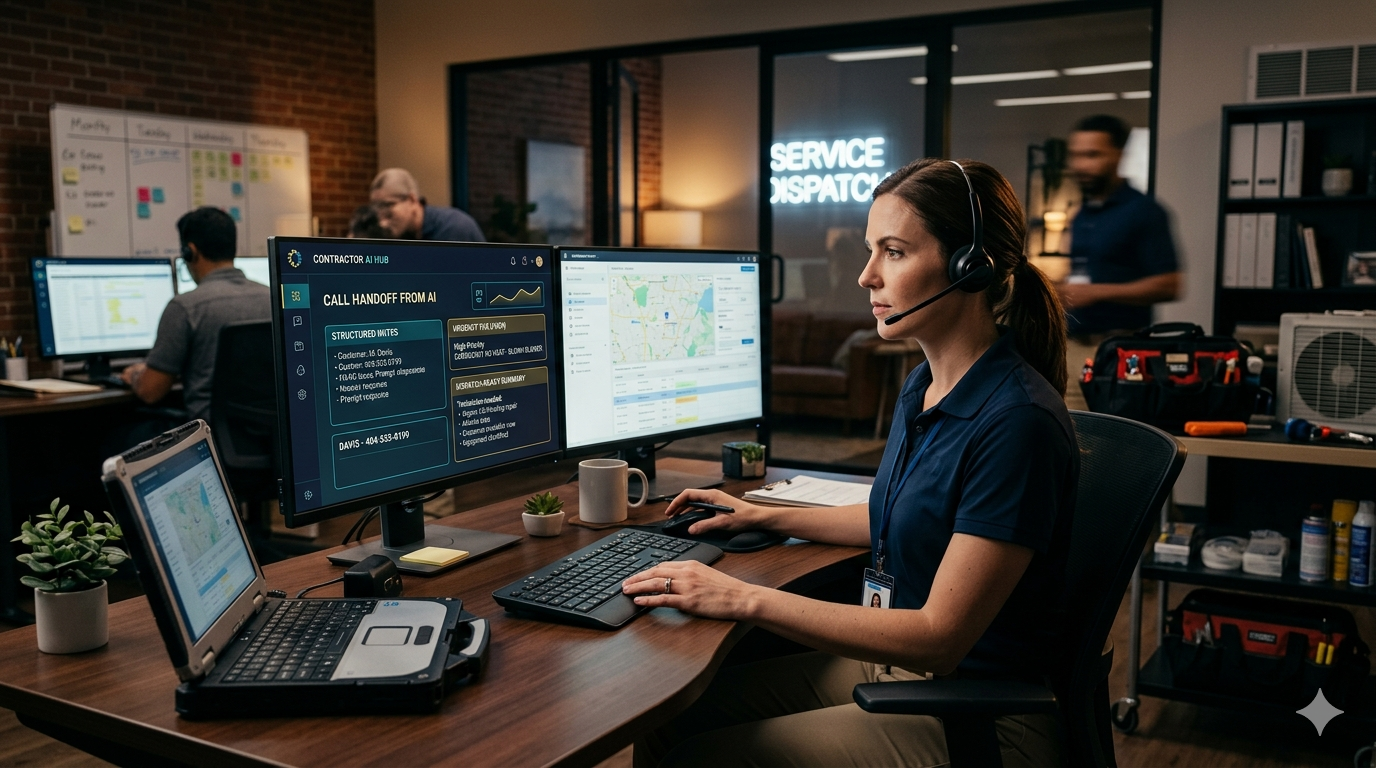
The office should not need to open a transcript and reconstruct the conversation. Require a structured summary that lands where the team already works. A useful call record includes:
- caller name and verified callback number
- new or existing customer status
- service address and service-area result
- job type and plain-language problem summary
- urgency lane and the reason it was selected
- appointment, callback, or escalation commitment
- any customer constraint, such as tenant access or a locked gate
- recording or transcript link when the company’s policy allows it
Then verify the integration. A polished dashboard has little value if staff must copy every lead into the CRM, field service platform, or dispatch board. Ask whether the service can find an existing customer, avoid duplicate records, write to the correct fields, and trigger the notification method the team actually watches.
Run adversarial test calls before signing off
A friendly scripted demo proves almost nothing. Build a test sheet from real call patterns and make the service handle them without coaching. Include a new lead who speaks indirectly, an existing customer with two open jobs, an address near the service-area boundary, a caller asking for an exact price, a noisy jobsite call, a frustrated warranty customer, and an urgent situation that requires a human.
Score each call on operational results:
- Did it classify the caller and job correctly?
- Did it collect the required facts without excessive repetition?
- Did it avoid making an unsupported promise?
- Did the correct employee receive the handoff quickly?
- Did the customer hear a clear, accurate next step?
- Could the office act without listening to the full recording?
Also test failure behavior. Interrupt the caller. Change the address. Ask to speak to a person. Give an unclear answer. Call when the integration is unavailable. A dependable system should recover cleanly or escalate; it should not hide uncertainty behind a confident voice.
Compare cost against recoverable value
Vendor pricing may combine a platform fee, included minutes, usage charges, phone numbers, integrations, implementation, and premium support. Model the likely call mix rather than comparing headline prices. Long qualification calls, transfers, spam, and seasonal surges can change the bill.
Then compare the full monthly cost with recoverable value. Use the company’s own numbers: qualified calls currently missed, the portion the team can realistically serve, booking rate, average gross profit per completed job, and staff time saved from cleaner intake. Do not count every answered call as revenue. A sales pitch, out-of-area request, or job the schedule cannot accept has little recoverable value.
The calculation needs a decision threshold, not false precision. If the service must recover three additional profitable calls per month to pay for itself, the pilot can test that. If it needs thirty calls the company has no capacity to run, the purchase is not operationally sound.
Pilot one lane and keep a human fallback
Launch with a limited call window or call type, such as after-hours new service leads. Keep the existing fallback available while the team reviews the first conversations. For two to four weeks, check every promise, escalation, booking, duplicate record, and caller complaint. Tighten scripts and routing rules from evidence rather than personal preference.
Assign one owner for configuration and one for daily exceptions. Without ownership, staff may complain about the output while nobody corrects the rule that caused it. Give the office a simple way to flag a bad summary, wrong lane, or missed escalation so the system can improve without a meeting.
Measure more than answer rate. Track qualified opportunities captured, valid appointments, response time after handoff, urgent calls accepted, records requiring manual repair, cancellations tied to incorrect expectations, and cost per usable opportunity. Compare the pilot with the same call window before launch.
Use AI for coverage, not avoidance
Some callers need a person: a customer disputing work, a complex project lead, someone who cannot communicate through the script, or a situation with meaningful safety, legal, or reputation risk. Make human transfer easy and visible. Review recording, transcription, and disclosure practices with qualified local guidance before launch, because the operating requirements depend on where the business and callers are located.
The strongest model for many contractors is hybrid. AI handles predictable intake, overflow, and after-hours structure. CSRs and managers handle judgment, recovery, and exceptions. That gives the team broader coverage without pretending the first conversation is always routine.
Buy a reliable next step
An AI answering service for contractors earns its place when callers receive a faster response and the office receives a cleaner job to do. Define the coverage gap, map call lanes, restrict promises, test difficult scenarios, and measure recoverable value before expanding.
The voice can sound impressive and still create chaos. The better buying standard is quieter: every important call reaches a reliable next step, and the team can keep the promise the caller heard.