
A callback can look harmless on the schedule: one technician, one hour, one quick return. The invoice tells a different story. That visit can displace a paying job, add drive time, consume parts, reopen a customer conversation, and force the office to rearrange the day. If the same cause keeps repeating, the company is not dealing with isolated mistakes. It is carrying an operating defect that quietly taxes capacity and margin.
AI callback analysis can make those defects easier to see. The useful version is not an automated blame report or a dashboard full of vague trends. It is a disciplined weekly review that turns scattered dispatch notes, job summaries, photos, invoices, and customer messages into a small set of verified causes and corrective actions.
Callback counts reveal volume, not cause
Most contractor software can count repeat visits. The difficult question is why they happened.
Two jobs may both be labeled “callback,” yet require completely different responses. A furnace return could trace to an incomplete diagnosis, a missing part on the truck, or a customer who was never shown how the new thermostat works. A remodeling return could come from poor workmanship, vague scope language, a missed punch item, or an unresolved expectation that started during sales.
If those events are grouped together, the callback rate becomes a weak management number. It says waste exists but does not tell an owner where to intervene. Worse, a broad label encourages broad fixes: remind everyone to communicate better, tell technicians to slow down, or add another checklist. None of those changes will hold unless they address the failure point.
AI helps when it compares the language and context across many jobs. It can surface repeated phrases, missing inputs, job types, equipment, crews, and process stages that would be tedious to connect manually. A manager still decides what the evidence means.
Define a callback before analyzing one
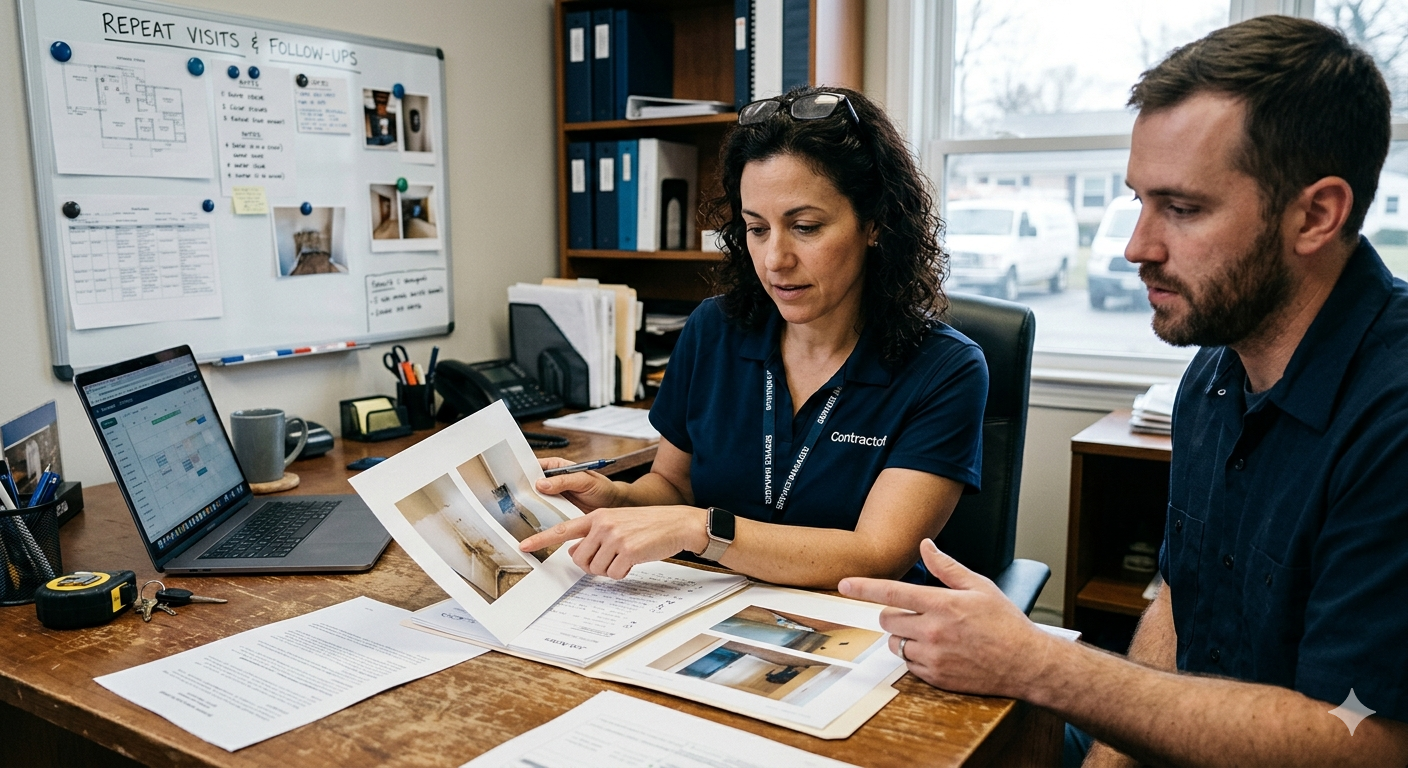
The review will fail if each dispatcher, project manager, or technician uses a different definition. Establish a simple operating rule first. A callback is usually an unplanned return connected to recently completed work, but the company should decide which events are included and which are tracked separately.
For example, exclude a scheduled second phase, a customer-approved add-on, and a new unrelated failure. Keep warranty work visible, but distinguish a manufacturer defect from an installation issue. Flag a courtesy visit separately when the work was correct and the customer needed instruction or reassurance.
Each callback record should include a minimum evidence packet:
- Original job number, service type, and completion date
- Return date, labor time, drive time, and parts used
- Original scope, technician or crew, and closeout notes
- Customer-reported issue and verified field finding
- Photos, equipment details, or relevant message history
- Final resolution and the manager-approved cause category
The goal is not perfect data. It is enough consistent context to stop the AI from guessing based on one frustrated sentence in a dispatch note.
Use cause categories that point to an owner
A useful category should lead to a business response. “Technician error” is often too blunt, while “communication problem” is too vague. Start with a short taxonomy and refine it only when the review proves that a distinction matters.
Diagnosis and workmanship
These callbacks involve an incorrect diagnosis, incomplete repair, failed installation step, or finish-quality defect. The response may involve coaching, inspection, testing standards, or a change in allotted job time. The evidence must distinguish individual execution from a process that routinely sets people up to rush.
Scope and expectation
The work may match the crew’s instructions while still disappointing the customer. Proposal language, exclusions, selections, or closeout explanations may have left room for two interpretations. These cases belong in sales and production review, not only in field training.
Parts, tools, and job readiness
The first visit could not close because the required material, equipment history, access information, or specialized tool was missing. Repeated cases often point to intake, purchasing, truck stock, or pre-job planning rather than workmanship.
Handoff and scheduling
Important information failed to move from customer to office, sales to production, or technician to dispatcher. A rushed time window can also produce an incomplete first visit. These callbacks need an owner in the workflow, not a general reminder in the next team meeting.
Product failure or customer education
Some returns are not preventable quality failures. Equipment can fail, and customers sometimes need help using a new control or understanding normal system behavior. Track these events so they do not distort crew performance, then decide whether better product selection or a stronger handoff could still reduce them.
Build a weekly AI callback review
The best cadence is usually weekly. Daily analysis reacts to too little evidence; monthly analysis lets patterns become expensive habits.
1. Export the week’s callback packet
Pull only the fields needed for the review. Remove payment data and personal details that do not affect the cause. If the company uses an outside AI tool, confirm its data controls before uploading customer records, photos, or employee information.
2. Ask for evidence-backed clustering
Give the AI the approved cause categories and require it to cite the job numbers and note fragments supporting each proposed cluster. It should identify missing information, alternative explanations, and low-confidence classifications instead of forcing every case into a neat answer.
A practical instruction might be: “Group these repeat visits by likely operating cause. For each cluster, list the supporting job IDs, common evidence, possible contributing process, and information needed for manager verification. Do not assign employee fault or invent facts.”
3. Verify every material pattern
An operations manager, service manager, or production lead should review the source records behind the largest and most expensive clusters. AI may connect similar wording that represents different field conditions. It may also mistake a commonly used note template for a real trend. Verification is the control that turns a plausible summary into a business decision.
4. Choose one corrective action per pattern
Do not respond with a long improvement list. Assign a specific action, owner, and review date. That could mean adding one photo to closeout, changing a proposal clause, updating a truck-stock rule, extending the booked time for a job type, or coaching a diagnostic sequence.
5. Check whether the fix changed the result
At the next review, compare the affected job type or process with its prior baseline. If the same callback remains, the action may have targeted a symptom. If the callback drops but first-visit time rises sharply, the company should decide whether the tradeoff still improves total capacity and gross profit.
Track cost and preventability, not just rate
Callback rate is useful, but it can hide the operational weight of each event. A ten-minute customer education visit and a two-person rework day should not carry the same management priority.
Track a small scorecard:
- Callback labor and drive hours
- Parts, credits, refunds, and subcontractor cost
- Paying appointments or production time displaced
- Days from original completion to reported problem
- Preventable, partially preventable, or non-preventable classification
- Repeat cause by job type, process stage, and branch or crew
Avoid publishing a simplistic employee leaderboard. Callback data can be skewed by job difficulty, inherited work, training assignments, and who gets sent to the hardest customers. Use person-level patterns as a prompt for evidence review, not as an automatic performance verdict.
What a useful finding looks like
Imagine an HVAC company sees six returns after heat-pump replacements. A shallow report says one installation team has the most callbacks. A stronger review shows that four jobs share missing startup readings, three were booked without enough commissioning time, and two customers called about normal defrost behavior.
Those findings lead to three different actions: require a startup photo set, adjust the schedule template, and add a customer handoff explanation. The company can then measure whether repeat visits fall without unfairly treating every return as the same installation failure.
That is the standard for AI callback analysis: a pattern must be specific enough to change a process and traceable enough for a manager to verify.
Turn repeat visits into operating feedback
Standing behind the work will always require some return visits. The objective is not a zero-callback slogan. It is to stop avoidable callbacks from becoming accepted overhead and to separate genuine quality failures from scope, readiness, handoff, product, and education issues.
A weekly, evidence-backed review gives contractors a practical learning loop. AI does the heavy sorting; managers supply judgment; owners assign the fix; the next set of jobs shows whether it worked. That is how callback data protects more than a quality score. It protects schedule capacity, customer trust, and margin.