
The most expensive call in an HVAC or plumbing company is often the one nobody hears. It arrives after 6 p.m., during lunch, while the office is handling another customer, or on a weekend when the on-call tech is buried. The homeowner does not think of it as a lead. They think of it as a hot house, a cold house, a leak, a failed water heater, or a problem that needs a competent response now.
AI missed call handling is useful because it gives contractors a structured way to respond before that customer calls the next company. The goal is not to pretend the business has a full night-shift dispatcher if it does not. The goal is to capture the opportunity, understand the urgency, protect the company's promises, and hand the office a clean record that can be acted on quickly.
Why missed calls deserve their own workflow
Most contractors treat missed calls as a phone problem. They are really a revenue, trust, and operations problem.
An unanswered call can represent a repair, a replacement, a maintenance plan, a future referral, or a customer who already searched locally and chose your company first. If that caller reaches voicemail and receives no useful next step, the business loses more than a phone conversation. It loses the first position in the customer's decision.
HVAC and plumbing make this sharper because the caller's situation is often time-sensitive. Comfort problems, active leaks, sewer backups, no hot water, and shutoff questions create pressure. A slow response suggests the job may be slow too.
That does not mean every missed call needs an emergency truck roll. It means every missed call needs a reliable triage path.
What AI should handle and what it should not
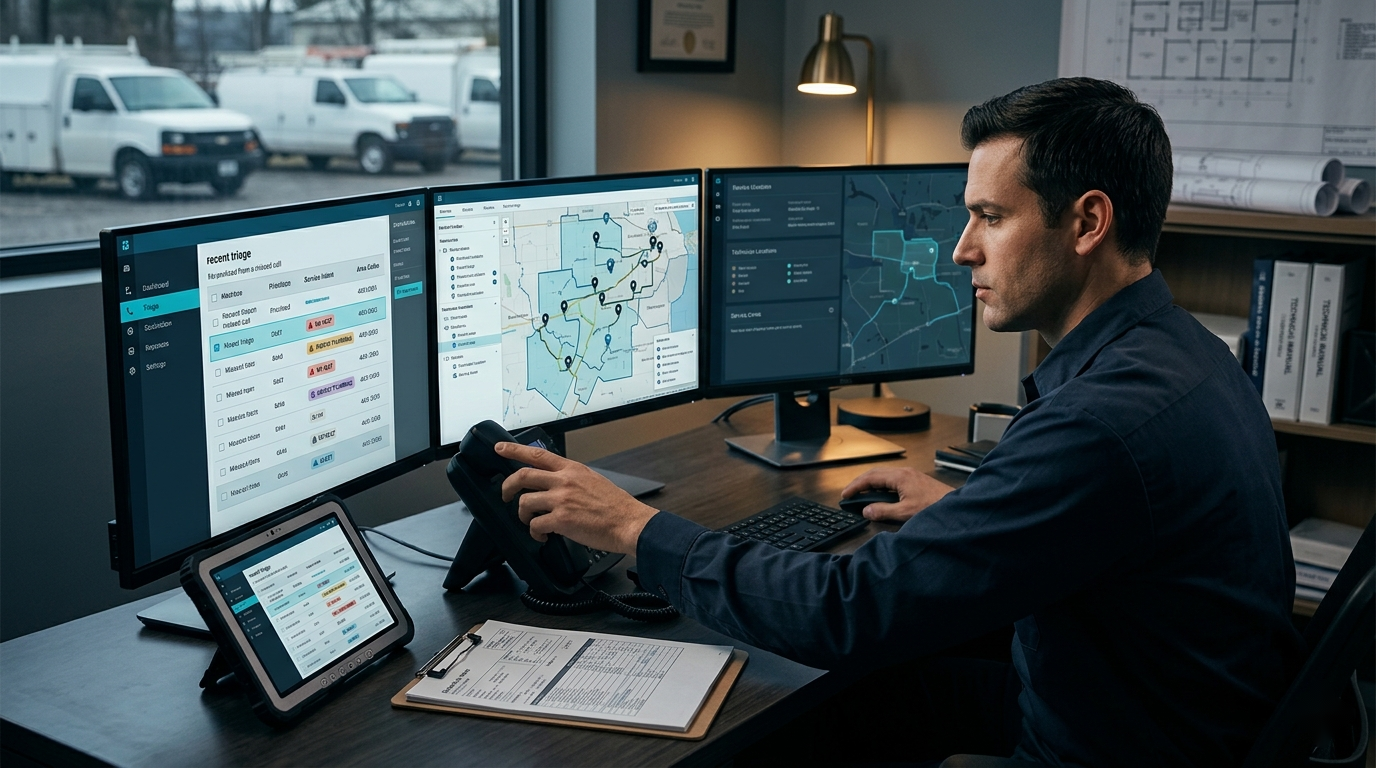
A good AI missed call system should behave like a disciplined intake layer. It can answer or return missed calls, collect basic details, ask urgency questions, summarize the conversation, and route the record to the right person.
It should not diagnose equipment, quote final pricing, promise availability, guarantee emergency service, or make commitments the office cannot keep. Bad automation creates cleanup work when it overpromises. Good automation makes the next human conversation easier.
The cleanest rule is simple: AI can gather and organize facts; the company decides, prices, schedules, and approves exceptions.
Build the intake around urgency, not curiosity
Many automated intake flows ask too many questions because the system is designed from the office's wish list instead of the customer's stress level. After-hours callers do not want an interview. They want to know whether someone understands the problem and what happens next.
For HVAC, the most useful first-pass details usually include:
- Whether the system is fully down or only underperforming
- Whether the home has vulnerable occupants, such as elderly residents or infants
- Whether the issue is heating, cooling, airflow, thermostat, or noise related
- Whether the customer is already a member or previous customer
For plumbing, the triage should move faster toward damage control:
- Whether water is actively leaking
- Whether the main shutoff has been located
- Whether drains are backing up or only slow
- Whether the issue affects the whole home or one fixture
- Whether there is property damage or safety risk
This requires the right few questions in the right order.
Set expectations without weakening the sale
Missed call handling fails when the message is either too vague or too bold. "Someone will get back to you" is weak. "A technician can be there tonight" is dangerous if that has not been confirmed.
The better middle ground is specific but honest. The system can say the company has received the request, is collecting details to prioritize it, and will route it according to the after-hours process. If there is a true emergency line, it can provide that path. If the business only schedules next-business-day service, it should say that clearly and capture the best callback window.
Customers can tolerate limits. They react badly to uncertainty and broken promises.
Turn every missed call into an office-ready summary
Raw call recordings and full transcripts are useful for review, but they are not enough for morning operations. The office needs a short summary that supports action.
A strong missed-call summary should include customer name, callback number, service address or ZIP code, trade, problem type, urgency indicators, membership status if known, requested timing, and recommended next step.
For example, "no cooling" is less useful than "No cooling since this afternoon; elderly parent in home; customer is in North Phoenix; previous maintenance customer; wants earliest callback; no pricing discussed." That summary helps the office prioritize without replaying the call.
Connect the workflow to dispatch rules
AI missed call handling becomes more valuable when it is tied to simple routing rules. Without routing, the system merely collects cleaner voicemails.
Start with a few practical categories:
- Emergency or potential property damage
- High-priority comfort issue
- Existing customer or maintenance plan member
- Replacement opportunity
- Routine repair request
- Non-service-area or low-fit inquiry
Each category should have a next action. Emergency issues may trigger an on-call alert. Existing maintenance customers may receive a different callback priority. Replacement inquiries may go to a comfort advisor. Non-service-area leads may receive a polite response without consuming dispatcher time.
The workflow needs to be consistent enough that the office trusts it.
Use AI to improve speed, not hide staffing limits
Owners sometimes buy missed call automation hoping it will solve staffing pressure by itself. It will not. If nobody reviews summaries, calls back promptly, or updates the CRM, the company has only made voicemail look more modern.
The real gain comes from reducing the amount of manual cleanup around missed calls. AI can remove the need to listen to every recording, rewrite messy notes, or guess whether a lead was urgent. That gives the office more time for the work that still requires judgment: deciding priority, calming the customer, assigning the right person, and protecting the schedule.
In a small shop, the owner starts the morning with a ranked call list instead of a voicemail queue. In a larger shop, dispatch sees urgent plumbing calls separately from next-week maintenance requests.
Keep the language local and plain
Customers calling an HVAC or plumbing company do not want polished software language. They want a competent local response.
The script should be short, calm, and direct. It should avoid fake empathy, long apologies, and phrases that feel like a national call center. It should also avoid asking the same question twice.
The best tone is practical: we received your request, we need a few details to route it correctly, here is what happens next, and here is what we cannot promise until a person reviews it.
Measure recovery, not just response volume
The easiest metric is how many missed calls received an AI response. That is useful, but it is not the business outcome.
Better metrics include contact rate after missed calls, booked jobs from after-hours inquiries, average callback time, emergency escalation accuracy, recovered revenue, and the percentage of summaries that required office correction. If summaries are often wrong or incomplete, the script or prompt needs adjustment.
It is also worth tracking lead quality by time of day. Some contractors discover that evening missed calls contain more urgent repair work. Others find that weekend calls include more unqualified shoppers. Either way, the data helps the owner decide whether to extend office coverage, adjust on-call rules, or improve web messaging.
Common mistakes to avoid
The first mistake is letting AI sound more certain than the company can be. The system should never invent appointment windows, pricing, warranty coverage, financing approval, or emergency availability.
The second mistake is treating HVAC and plumbing as the same call type. Comfort loss and water damage create different urgency signals. The intake should reflect that.
The third mistake is failing to stop automation after a human takes over. If a customer has already received a dispatcher callback, the system should not keep sending generic missed-call follow-ups.
The fourth mistake is leaving the CRM disconnected. Missed call handling should update the lead record or at least create a structured task. Otherwise, the office still has to copy details by hand.
The practical payoff
AI missed call handling works when it makes the company faster, clearer, and more organized at the exact moment a customer is deciding who to trust. For HVAC and plumbing companies, that moment often happens outside normal office hours.
The best setup is not flashy. It is a tight operating system: clear guardrails, trade-specific triage, honest expectations, clean summaries, and routing rules the team actually follows. Done well, AI does not replace the dispatcher or the technician. It protects the lead until the right person can act.
That is where the revenue is recovered. Not in sounding automated. In making sure the customer who called first does not become somebody else's job.